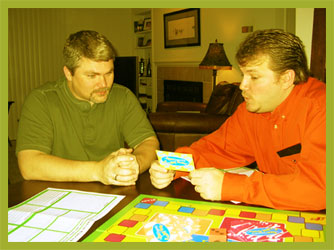
The Home Ownership Reality Game™ is a board game with four different color spaces
around the board and two "paydays" located in opposite corners. There are four
color-coded decks of cards which correspond to the colored spaces on the game
board. Each deck contains cards related to a different topic that new homeowners
will encounter:
Emergency Repairs
Scheduled Maintenance
Financial Issues
Life Happens
Each card outlines an issue that the participants must
resolve using the options provided on the card. Players must record
their decisions on their score card - the Financial Planning Worksheet.
Players work in teams of two with two or three teams at each game board.
The Home Ownership Reality Game can be played in a classroom setting with
multiple game boards operating simultaneously. Family members playing the
game as a team is one approach for learning, although the design encourages
splitting up households at particular points to allow exploring new patterns
of decision-making.
Each team is given a profile of a family for each
round. This profile explains that family's current situation including: how many people
are in the household, the monthly household income, assets (money in checking and/or
savings) and liabilities (car loans, credit cards, etc.). The profile also includes
a list of monthly expenditures which is presented as the household budget. Each team
is provided a Financial Planning Worksheet to use throughout the game for each family
profile. The game begins with each team entering on their worksheet the beginning
balances in the checking and savings account for their family profile.
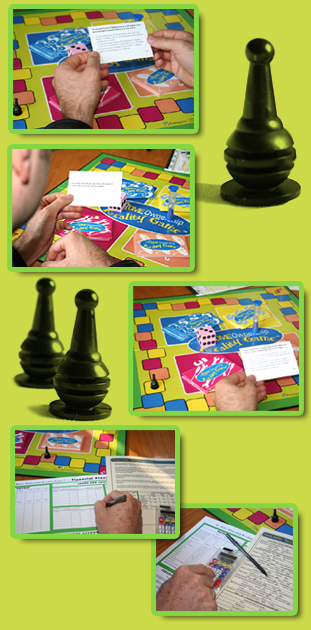
A roll of the die moves the single game piece around the
board. Players then draw a card from the deck corresponding
to the colored space they land on and read the card to the other
players. The entire table then discusses the issue raised on the card
and the options that are presented. Each team at the table makes its own
decision about how to address the issue(s) on the drawn card and adjusts their
financial worksheet accordingly. Part of the learning process is comparing the
results of different decisions when the starting point was the same for everyone.
Each round of the game takes 60 - 90 minutes to play. The game is designed to be
played in three separate sessions with one or two weeks between sessions for
"homework", but the game can also be used in other time formats.









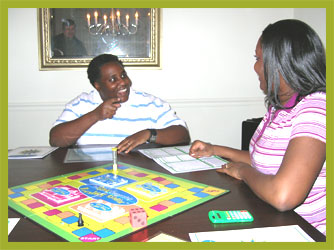 The Home Ownership Reality Game™ is a board game with four different color spaces
around the board and two "paydays" located in opposite corners. There are four
color-coded decks of cards which correspond to the colored spaces on the game
board. Each deck contains cards related to a different topic that new homeowners
will encounter:
The Home Ownership Reality Game™ is a board game with four different color spaces
around the board and two "paydays" located in opposite corners. There are four
color-coded decks of cards which correspond to the colored spaces on the game
board. Each deck contains cards related to a different topic that new homeowners
will encounter: